|
China to Dominate Flat Panel Display Manufacturing by 2018, IHS Says
11/6/2015 |
|
|
Despite falling prices and profit margins, BOE and other Chinese panel manufacturers continue ambitious expansion plans
KYOTO, Japan (November 5, 2015) - While conventional thin film transistor liquid crystal (TFT LCD) displays are rapidly trending towards commoditization and currently suffering from declining prices and margins, China is quickly adding capacity in all flat-panel display (FPD) manufacturing segments. Supported by financial incentives from local governments, Chinese TFT capacity is projected to grow 40 percent per year between 2010 and 2018. In 2010 China accounted for just 4 percent of total TFT capacity. However by 2018, China is forecast to become the largest FPD-producing region in the world, accounting for 35 percent of the global market, according to IHS Inc. (NYSE: IHS), the leading global source of critical information and insight.
While Chinese capacity expands, Japan, South Korea and Taiwan have restricted investments to focus mainly on advanced technologies. TFT capacity for flat panel display (FPD) production in these countries is forecast to grow on average at less than 2 percent per year between 2010 and 2018.
Based on the latest IHS Display Supply Demand & Equipment Tracker, BOE Technology Group stands out as the leading producer of FPDs in China. With a capacity growth rate of 44 percent per year between 2010 and 2018, BOE will become the main driver for Chinese share gains. By 2018, the company will have ramped up more FPD capacity than any other producers, except for LG Display and Samsung Display.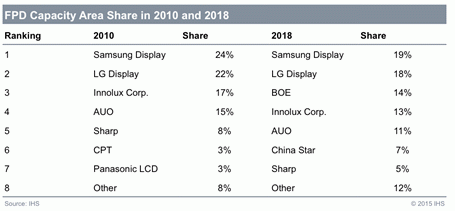
"Despite growing concerns of oversupply for the next several years in most parts of the display industry, there is still little evidence that Chinese makers are reconsidering or scaling back their ambitious expansion plans," said Charles Annis, senior director at IHS. "On the contrary, there continues to be a steady stream of announcements of new factory plans by various regional governments and panel makers."
In China the central government has generally encouraged investment in FPDs, in order to shift the economy to higher technology manufacturing, to increase domestic supply and to support gross domestic product (GDP) growth. Provincial governments have become the main enabler of capacity expansion through product and technology subsidies, joint ventures and other direct investments, by providing land and facilities and through tax incentives. In return, new FPD fabs increase tax revenue, support land value appreciation, increase employment and spur the local economy. The economic benefits generated from the feedback loop between local governments, panel makers and new FPD factories are still considered sufficiently positive in China to warrant application of significant public resources.
"China currently produces only about a third of the FPD panels it consumes. However, by rapidly expanding capacity, panel makers and government officials are expecting to double domestic production rates in the next few years and are also looking to export markets," Annis said. "How excessive global supply, falling prices and lower profitability will affect these plans over time is not yet exactly clear. Even so, there is now so much new capacity in the pipeline that China will almost certainly become the top producer of FPDs by 2018."
|
|
|
|
|
|
主站蜘蛛池模板:
国产国产午夜福利视频|
在线高清亚洲精品二区|
91狼友社|
97精品人妻系列无码人妻老牛|
性爱福利导航|
久久中文字幕一区二区|
911国产精品|
太原市|
亚洲日日噜噜噜夜夜爽爽
|
少妇人妻88久久中文字幕|
午夜福利网|
丁香婷婷色综合激情五月|
99精品丰满人妻无码一区二区|
日韩成人精品中文字幕18禁|
AV无码人妻一区二区三区牛牛|
亚洲精品综合第一国产综合|
亚洲avav天堂av在线网爱情|
国产午夜精品久久精品电影|
久久这里只有精品23|
性中国videossexo另类|
国产av熟女一区二区三区|
亚洲AV成人无码久久精品四虎|
国产成人高清精品免费|
欧美www在线观看|
亚洲精品日韩中文字幕|
亚洲人成欧美中文字幕|
天天躁夜夜躁狠狠综合|
jizz日本69|
激情婷婷五月天|
国产一区二区波多野结衣|
国偷自产视频一区二区久|
任我爽精品视频在线播放|
久久国产免费观看精品3|
国产男女猛烈无遮挡免费视频网站
|
免费看国产成年无码av|
国产成人无码一区二区三区在线|
亚洲av伊人久久综合性色|
天海翼无码在线|
亚洲成人免费电影|
99久热国产精品视频尤物|
亚洲综合无码明星蕉在线视频|