|
New high temperature resistant Arnitel TPE from DSM replaces plastics-rubber and metal-rubber combinations in hot air ducts
6/23/2016 |
|
|
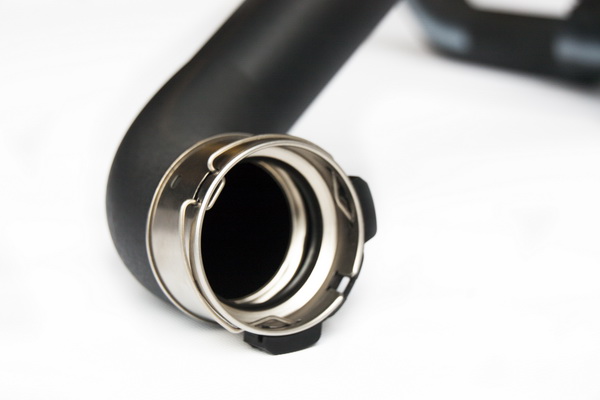
Royal DSM, a global science-based company active in health, nutrition and materials, has developed a new high temperature resistant grade of its Arnitel® thermoplastic copolyester elastomer (TPC) for production of flexible hot charge air ducts used in turbocharged engines.
Arnitel HT will allow system suppliers to produce the ducts in a single material and using a single process step. The current standard practice is to assemble separate elements in hard thermoplastics or metal and soft thermosetting rubbers, which need to be produced in diverse operations. Switching to Arnitel HT will provide producers with a significant improvement in process efficiency, cost reductions of up to 50% and weight reduction of up to 40%.
Hot charge air ducts are common features in advanced petrol and diesel engines. They transfer hot compressed air from the turbocharger or the supercharger to the intercooler in a system that increases the efficiency of the engine by using higher operating pressures.
The ducts obviously need to withstand very high temperatures for long periods; furthermore, in order to handle movements of the engine relative to the cooler (which is fixed on the chassis of the car) and because they need to be easy to install, flexibility is an important requirement. These needs are normally met by using ducts with a central section in a rigid high temperature thermoplastic such as DSM's Stanyl® or Akulon® polyamide, and end sections in a thermosetting polyacrylate, ethylene acrylic or fluoro rubber with a woven reinforcement.
There are several disadvantages associated with this approach, the two most important of which are weight and cost. Assemblies based on these thermoset rubbers are heavy, because their relatively low mechanical performance dictates the need for thick walls to be able to handle the demands of the hot charge air duct.
In addition, total system costs of rubber-plastics (or metal)-rubber solutions can be quite high, for various reasons. The production process is a multi-step one: molding of the various elements, followed by assembly; this adds costs and takes extra time, and it also introduces extra opportunities for defects to be introduced, both during production and in use. Because rubber processing and plastics processing require different skills, companies producing the ducts may even buy some sections rather than make them themselves. In addition, to reduce the risk of failure due to creep at the joints in these assemblies, reinforcement rings are placed inside the tubes, another assembly step.
Also not to be overlooked is the environmental disadvantage. Rubber is not easy to recycle, while energy consumption during processing as well as the working environment for operators leave a lot to be desired in terms of sustainability.
Arnitel HT eliminates all these disadvantages. With its ability to withstand continuous operating temperatures of up to 180C and peaks of up to 190C, it has high temperature resistance unequalled among thermoplastic elastomers. Arnitel HT also has good resistance to the sorts of oils and chemicals found in automobile engine environments.
Critically, Arnitel HT's combination of elasticity with high mechanical strength means that it can be used to produce the entire duct in a single piece, using 3D suction blow molding. Wall thicknesses can be approximately halved.
"Ducts produced in Arnitel HT can withstand the internal operating pressures which are demanded by car producers, not only for models in production today but also for upcoming generations," says Kurt Maschke, Global Segment Manager Air/Fuel at DSM. "And by using a single solution based on a material with excellent mechanical performance and a relatively low density in an optimized design, it is possible to obtain weight savings of as much as 40%."
DSM has been able to build on previous successes in improving the long-term thermal stability of Arnitel. Other grades have already proven themselves in existing duct applications requiring good heat resistance.
One of the first producers of hot charge air ducts to take advantage of this new innovation is CIKAUTXO, headquartered in Spain, which has capability in production of rubber components and also in plastics blow molding and injection molding. The company worked together with DSM on the development of the first part in Arnitel HT, and exchanged valuable information for improvements in the material, processing, and part validation.
"We believe that Arnitel HT will enable us to make important cost reductions and increase consistency and reliability in our production of high performance ducts," says Dr. Gurmendi at CIKAUTXO. "Our new ability to make better optimized parts in a single step provides us with a tangible advantage in the market." |
|
|
|
|
|
主站蜘蛛池模板:
欧美人禽杂交狂配|
91黄色视频在线观看|
欧美精品自拍|
亚洲国产欧美日韩一区二区|
亚洲 自拍 另类小说综合图区|
夜夜影院未满十八勿进|
亚洲狼人久久伊人久久伊|
亚洲成人av一区二区三区|
嫩草tb|
996久久国产精品线观看|
激情国产一区二区三区四区|
波多野结衣一区二区免费视频|
亚洲欧洲一区二区精品|
69国产|
人妻无码中文字幕免费中文仙人|
久久三级视频|
亚洲激情小说|
中文字幕亚洲国产精品|
亚洲熟妇自偷自拍另类|
黄色国产精品一区二区三区|
久久久无码专区|
伊人久久大香线蕉亚洲五月天|
91精品欧美综合在线野草社区|
色偷偷亚洲av男人的天堂|
色欲av狠狠躁天天躁|
精品国产精品中文字幕|
免费看欧美日韩一区二区三区|
超级黄色a毛片视频|
国产精品美女黑丝流水|
成人在线网址|
在线国产精品中文字幕|
久久精品夜色噜噜亚洲A∨|
日韩中文字幕av有码|
动漫AV纯肉无码AV电影网|
亚洲综合另类小说色区一|
中文字幕人妻色欲|
欧美日韩精品一区二区三区高清视频|
国产精品国产三级国产剧情|
亚洲成a人片在线观看中文|
美日韩精品综合一区二区|
欧美国产日产一区二区|