|
Carbon nanotube-graphene complexes show promise as low-cast, high-activity electrocatalysts for fuel cells or metal-air batteries
5/29/2012 |
|
|
A team of researchers has demonstrated the ability of "partially unzipped" carbon nanotubes to act as an oxygen reduction electrocatalyst in both acidic and alkaline solution. The work, led by Stanford University's Dr. Hongjie Dai, and reported in the journal Nature Nanotechnology, could lead to lower-cost alternatives to platinum for use in fuel cells and metal-aire batteries.
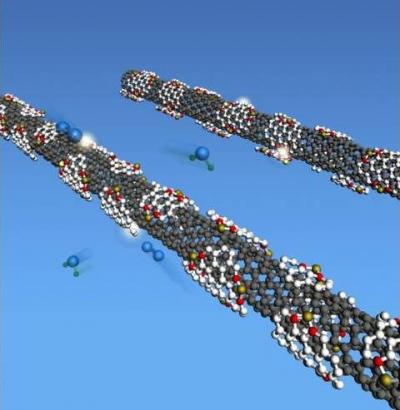
In the new process, the outer walls of the few-walled carbon nanotubes are partially unzipped, creating nanoscale sheets of graphene attached to the inner tubes (carbon nanotube-graphene complexes). The graphene sheets contain extremely small amounts of iron originated from nanotube growth seeds, and nitrogen impurities, which facilitate the formation of catalytic sites and boost the activity of the catalyst.
While the graphene sheets from the outer wall of the nanotubes are responsible for the catalytic activity, the inner walls remain intact and retain their electrical conductivity, which facilitates charge transport during electrocatalysis, the researchers found.
Platinum is very expensive and thus impractical for large-scale commercialization. Developing a low-cost alternative has been a major research goal for several decades. - Hongjie Dai
Oxygen reduction reaction catalysts based on precious metals such as platinum or its alloys are routinely used in fuel cells because of their high activity, the authors noted. However, over the past five years, the price of platinum has ranged from just below $800 to more than $2,200 an ounce.
Carbon-supported materials containing metals such as iron or cobalt as well as nitrogen impurities have been proposed to increase scalability and reduce costs, but these alternatives usually suffer from low activity and/or gradual deactivation during use.
The team showed that by leaving the inner walls intact, the carbon nanotube-graphene complexes exhibit enhanced catalytic activity without interfering with their ability to conduct electricity.
We found that adding a few iron and nitrogen impurities made the outer wall very active for catalytic reactions. But the inside maintained its integrity, providing a path for electrons to move around. You want the outside to be very active, but you still want to have good electrical conductivity. If you used a single-wall carbon nanotube you wouldn't have this advantage, because the damage on the wall would degrade the electrical property. - Hongjie Dai
The team found that the catalytic activity of the nanotubes is very close to platinum; the high activity and the stability of the design make them promising candidates for fuel cells.
The researchers recently sent samples of the experimental nanotube catalysts to fuel cell experts for testing. Multi-walled nanotubes could also have applications in metal-air batteries made of lithium or zinc.
The Stanford study might also have resolved a long-standing scientific controversy about the chemical structure of catalytic active sites where oxygen reactions occur.
One group of scientists believes that iron impurities are bonded to nitrogen at the active site. Another group believes that iron contributes virtually nothing, except to promote active sites made entirely of nitrogen. - Yanguang Li, lead author
The Stanford team enlisted scientists at Oak Ridge National Laboratory to conduct atomic-scale imaging and spectroscopy analysis of the nanotubes. The results showed clear, visual evidence of iron and nitrogen atoms in close proximity.
For the first time, we were able to image individual atoms on this kind of catalyst. All of the images showed iron and nitrogen close together, suggesting that the two elements are bonded. This kind of imaging is possible, because the graphene pieces are just one-atom thick. - Hongjie Dai
Dai noted that the iron impurities, which enhanced catalytic activity, actually came from metal seeds that were used to make the nanotubes and were not intentionally added by the scientists. The discovery of these accidental yet invaluable bits of iron offered the researchers an important lesson.
Other co-authors of the study are Hailiang Wang, Liming Xie and Yongye Liang of Stanford; Wu Zhou, Juan-Carlos Idrobo and Stephen J. Pennycook of Vanderbilt University and Oak Ridge National Laboratory; and Fei Wei of Tsinghua University.
This work was supported, in part, by a grant from the Precourt Institute for Energy at Stanford; Intel; Lawrence Berkeley and Oak Ridge national laboratories; the Department of Energy; and the National Science Foundation.
Resources
Yanguang Li, Wu Zhou, Hailiang Wang, Liming Xie, Yongye Liang, Fei Wei, Juan-Carlos Idrobo, Stephen J. Pennycook & Hongjie Dai (2012) An oxygen reduction electrocatalyst based on carbon nanotube-graphene complexes. |
|
|
|
|
|
主站蜘蛛池模板:
国内精自视频品线一二区|
国产一区二区不卡精品视频|
99国产精品久久久蜜芽|
国模精品无码|
国产日韩在线时看高清视频|
久久国产影院|
亚洲av免费成人精品区|
亚洲人妻精品中文字幕|
亚洲制服丝袜系列AV无码|
色欲人妻综合网站|
无码A级|
91精品国产高清久久久久久g|
日韩大片高清播放器|
久久午夜私人影院|
一区二区三区日韩|
日本丰满护士bbw|
宝清县|
日本亚洲欧美在线视观看|
日本边吃奶边摸边做在线视频|
日本亚洲一级中文字幕|
亚洲女同在线播放一区二区|
69精品人人人人|
醉红楼av|
日韩午夜激情成人福利|
自拍偷拍99|
伊伊色妹子在线视频|
亚洲精品无码久久一线|
国精品午夜福利不卡视频|
丰满人妻一区二区三区在线视频53
|
精品国产久一区二区三区|
久久蜜臀av一区三区|
成人精品自拍视频免费看|
亚洲另类综合网|
日韩AV无遮挡污污在线播放|
在线天堂最新版资源|
日本欧美大码aⅴ在线播放|
午夜福利精品一区二区三区|
国产高清在线不卡一区|
中文字幕视频一区二区|
t=&tags=%E5%90%8E%E5%85%A5%E9%AA
|
亚洲一区二区三区免费av在线|