|
Advanced 3D simulator speeds development of tube bending programs
9/26/2013 |
|
|
- Powerful real-time visualisation tool with collision detection helps metal fabricators optimise use of computer-controlled bending machines
Dramatically shortens design-to-manufacture time - from days to minutes!
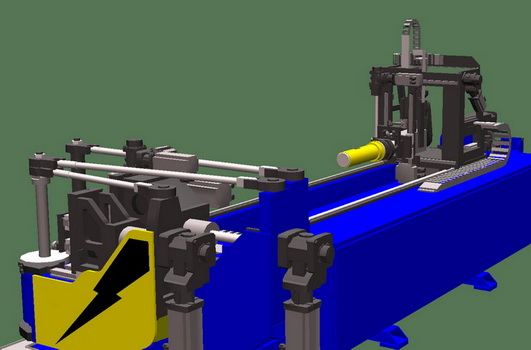
Scarborough, UK, September 25, 2013 - Unison has launched an advanced three-dimensional simulator to help metal fabricators accelerate the development of control programs for all-electric tube bending machines. Using artificial intelligence techniques, the simulator provides powerful program analysis and optimisation facilities, together with realistic real-time visualisation of the tube bending process.
The simulation software is valuable in almost all tube bending applications, but can be particularly helpful for fabricators quoting on jobs and planning production, in reducing design-to-manufacturing times to help speed product delivery, and on any application involving tubes manufactured from expensive alloys. Customers with several Unison machines can also use the software to choose the most appropriate machine for bending a particular part.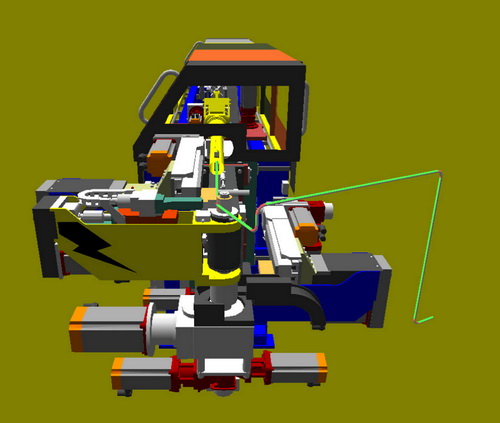
Unison's new 3D simulator is based on true CAD (computer-aided design) models of the target machines, resulting in exceptionally detailed computer-generated imagery. The simulator is designed specifically to help users develop high quality production-standard tube bending programs without the need to test and optimise them on the target machine. Used in conjunction with Unison's Windows-based Unibend control software, it enables fully validated bending programs to be created entirely off-line, and is suitable for any machine in the Breeze range of all-electric tube benders.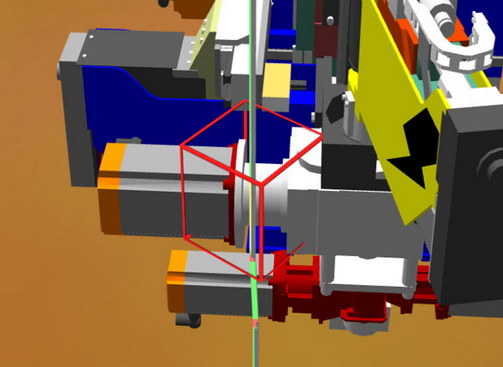
One of the most time-consuming tasks normally faced by users is structuring the program to prevent any collisions between the tube and the bending machine, or its surroundings such as the production floor. It is difficult to visualise the combined effect of tube feed and rotation, and the movement of machine tooling such as clamping and pressure dies, and the bending head. The problem becomes more acute as the length of tube, or the complexity of bends, increases. As a result, optimising the program's bending sequence and incorporating any necessary correction feeds for collision avoidance is usually an iterative task demanding valuable machine time. It also invariably involves producing trial parts, creating unnecessary scrap material.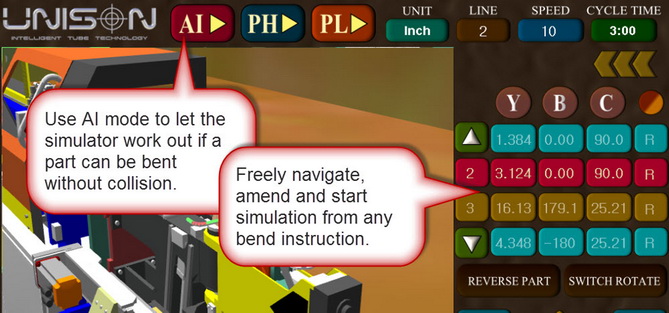
Unison's 3D simulator incorporates fully automated collision detection capabilities and offers a choice of real-time or batch operating modes to create error free bend instructions. In real-time mode, simulation can be paused at any time and can be started from any bend; changes made to bend instructions will cause the simulator to re-evaluate the motion profile of the machine - ensuring that the simulator always mirrors the sequences used on the real machine. In batch mode, the simulator will study a directory tree and process all bend instruction files in that tree; parts that can be bent will be stored in a designated folder and parts for which the simulator could find no collision-free solution will be stored in a quarantine folder for further analysis by production or design teams. During beta trials of the simulator, one customer reported that by using batch mode they had fully analysed and verified the bending programs for 300 parts in 4 hours - a task that previously took up to 5 working days due to the need for machine time, and operator involvement, to trial every part.
Without simulation, ascertaining whether it is even possible to bend a part on a particular machine can take several days. After creating the part model on a CAD system, the designer processes the data using Unison software to create a YBC file which defines each bend in three dimensions. The file is then transferred to the machine where it runs under control of Unibend software - the operator is responsible for checking if it creates the desired part. Any need for changes are fed back to the designer, and after modification the program is tested again on the machine. This process often needs to be repeated several times to resolve successive problems.
Unison's 3D simulator shortens the design-test-optimise process dramatically, eliminating the need for a bending machine and its operator until manufacturing commences. For example, designers can now typically verify whether a part can be bent within about 3 minutes. The simulator accepts the same YBC file that is normally used to control the bending machine and runs it offline, to create a motion profile that defines how each axis on the real machine will move. The designer can then simulate the part to check its design. The simulator's physics engine has access to a database containing configuration details of every machine in Unison's Breeze range of tube benders, together with comprehensive performance data for all motorised axes, enabling the computer-generated imagery to be controlled accurately and realistically
Users can save the results of simulations and rerun them at any time for comparison purposes. Artificial intelligence (AI) techniques are employed to help users select the most efficient bending sequences and optimise them to minimise machine cycle time. The simulator's AI is aware of the capabilities of the machine and can work through all permutations very quickly. Furthermore, if customers have specific ?rules' that they want including in the AI, these can be incorporated easily - Unison has already implemented this option for several customers.
Unison believes that it is very important to ensure detection of every collision, and the company's software development team has written a custom physics engine that is accurate to 0.005 mm. Whilst this is in advance of the mechanical accuracy of real machines, customers surveyed opted to have highly accurate simulation with the option to ?ignore' a collision rather than use a tolerance which could lead to missed collisions. All types of collisions are detected in the simulator, including tube on tube, tube on environment, tube on machine, machine on machine and tube spring-back.
To maximise bend accuracy, the simulator factors in the tendency for metal tubes to spring back after being bent. There are two elements to spring-back correction; a proportional element which is determined by the programmed bend angle, and a fixed element which depends on the type of tube material and its size and thickness. The value of the fixed element is based on empirical data held in a materials database, which the user can update when testing new batches of raw material, or as a result of sampling production parts under a quality assurance programme.
According to Unison's Jim Saynor, "Real-time 3D simulation of tube bending allows metal fabricators to achieve significant cost savings through much faster program development and reduced scrap. We believe that our new simulator provides a much more detailed and realistic portrayal of machine performance than competitive software, providing users of Unison all-electric tube benders with a major business advantage." |
|
|
|
|
|
主站蜘蛛池模板:
国产亚洲精品第一综合|
青青青国产精品国产精品美女|
国产女人喷潮视频免费
|
亚洲国产精品不卡毛片a在线|
猫咪AV成人永久网站在线观看|
精品婷婷色一区二区三区|
人成午夜免费视频无码|
亚洲男人天堂网|
国产熟妇与子伦hd|
伊人久久无码中文字幕|
中文字幕乱码亚洲无线精品一区|
国产精品天天干|
久热伊人精品国产中文|
无码专区 人妻系列 在线|
亚洲国产人成在线观看69网站|
亚洲成人久|
午夜AAAAA级岛国福利在线|
日韩欧美一|
国产农村激情免费专区|
风韵丰满妇啪啪区老老熟女杏吧
|
亚洲精品国产摄像头|
99re一区二区三区|
人妻少妇乱子伦精品无码专区毛片|
人妻综合第一|
另类专区一区二区三区|
亚洲综合精品一区二区三区|
最新在线精品国自产拍福利
|
亚洲AV无码专区亚洲AV紧身裤|
同性男男黄gay片免费|
性色av无码久久一区二区三区|
亚洲成人视频|
久久综合九色综合欧洲98|
中文久久AV影院|
精品美女少妇内射毛片|
国产av无码专区亚洲av软件|
国产中文成人精品久久久|
精品久久一线二线三线区|
91私拍|
天天爽天天爽夜夜爽毛片|
午夜福利精品视频|
亚洲精品国产精品精|