|
|
|
| Low Power Gas Sensors
|
|
Cambridge CMOS Sensors (CCS) is an industry leader in sensor technology for environmental sensor solutions for a wide range of applications. We are a leading supplier of CMOS MEMS Micro-Hotplates which provide the key technology platform for chemical resistive, and catalytic, gas sensors. This technology uses standard CMOS processes, making it ideal for high volume applications, in terms of scalability and cost.
Limitations of Classic MOX Gas Sensors
Classic MOX gas sensors are large and expensive, have high power consumption and suffer from the following limitations:
Cross Sensitivity - Generally non-specific and react to a multitude of gases
Drift - The baseline and sensitivity will vary from sensor to sensor and over time
Stabilisation - The stabilisation time is several hours to days before they reach a stable baseline
To counter these limitations, expensive and frequent calibration is needed. In addition, expensive filters are required to reduce cross sensitivity.
The Cambridge CMOS Sensors Technology Advantage
Our miniature gas sensors use a unique silicon platform with advanced sensing materials, which:
Reduces the baseline stabilisation time to a few seconds
Greatly reduces cross-sensitivity and enhances selectivity of gases
Enables ultra-low power consumption for portable handheld devices
Our patented CMOS MEMS Micro-hotplates technology provides the key technology platform for our Metal oxide (MOX) gas sensors by enabling sensor miniaturisation, significantly lower power consumption and ultra-fast response times for a wide range of applications.
Our Micro-hotplates are suspended in a high reliability membrane and act as heater elements for a metal oxide-based sensing material. The Micro-hotplates contain electrodes that measure the resistance of the sensing material. Reactions to target gases cause material resistance changes at temperatures between 200oC to 400oC.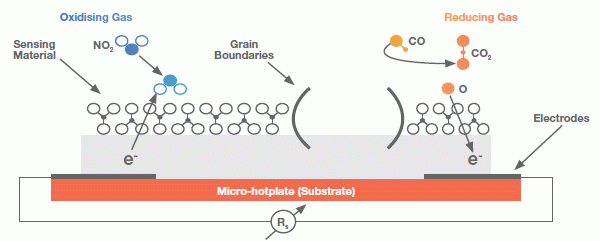
For reducing gases such as Carbon Monoxide (CO) a reaction takes place with the pre-adsorbed oxygen of the sensing material which decreases the resistance of the sensor. For oxidising gases such as Nitrogen Dioxide (NO2) the resistance increases. The magnitude of the resistive changes depends on the metal oxide composition/structure and the operating temperature of the sensor. Figure 1 illustrates the MOX gas sensor structure and how the resistance of the sensing material changes when gas molecules react on the surface.
The relationship between sensor resistance and the concentration of the target gas is non-linear and can be expressed by the following equation over a certain range of gas concentration: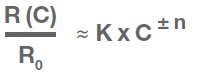
Where
R(C) is the resistance of the film at gas concentration C
R0 is the resistance at zero gas concentration
K is a sensitivity parameter measurement constant
n is a parameter that varies in the range 0.3 to 0.8
The positive sign is used for oxidizing gases and the negative sign is for reducing gases
Advanced algorithms support our family of MOX gas sensors for maximum selectivity, drift compensation and for self-calibration, enabling easy and timely integration into a wide range of applications. |
|
|
|
|
主站蜘蛛池模板:
夜夜添无码试看一区二区三区|
精品人妻一|
最新69国产成人精品视频免费|
欧美成人h精品网站|
成人国产精品一区二区不卡|
欧美第3页|
亚州av无码|
国产成人午夜福利院|
欧美国产日产一区二区|
制服.丝袜.亚洲.中文.综合懂|
亚洲综合一二|
色播亚洲视频在线观看|
国产女高清在线看免费观看
|
欧美88888|
亚洲永久中文字幕在线|
亚洲成a人v欧美综合天堂软件
|
亚洲成人网在线|
丁香五月缴情综合网|
国产日本一区二区三区|
97久久精品人人槡人妻人人玩|
疯狂的欧美乱大交|
久草热在线视频免费播放|
国产成人啪精品午夜网站|
99热成人精品国产免国语的|
99国产精品白浆在线观看免费|
精品人妻中文无码AV在线|
污网站免费观看|
中文字幕有码无码AV|
国产av仑乱内谢|
99在线播放|
制服.丝袜.亚洲.中文.综合,91,麻豆|
门头沟区|
亚洲欧美国产成人综合不卡
|
久久亚洲精品天天综合网|
四虎永久精品在线视频|
日韩伦理片|
国产永久AV福利在线观看|
成人国内精品久久久久影院|
久久无码精品精品古装毛片|
精品无码一区二区三区爱欲|
亚洲精品乱码久久久久久按摩高清|


 GUARDION - Next generation portable GC/MS chemical identifier & mixture analysis
 UltiMate 3000 Basic LC System