Opera 16: Electromagnetic & Multiphysics Software for Designers
The latest version of Vector Fields Software''s electromagnetic and multiphysics simulation software suite, Opera 16, includes many significant new capabilities and enhancements. These are summarised briefly below. Please see the new-features document which is distributed with the software for more information.
General:
New Graphing Capability
Functional Capacitors and Inductors in Circuits
Opera-2d and Opera-3d now make use of a new common graphing capability. The graphing function now works on the concept of buffers and lines being dynamically added/displayed on a dedicated graphing pane. Each of the graphing objects has a right-click context-sensitive menu allowing appropriate commands to be executed on the object. A wealth of properties can be adjusted by the user to assemble a graph to their exact requirements, including:
displayed text and fonts for title, axes labels, legend and annotation;
scale type (linear or log10) and limits for axes;
colours for lines, grid, axes, background and border;
styles for lines and grids;
symbol types and their size.
The previous graphing commands have been preserved for compatibility with previous command input files.
Functional Capacitors and Inductors in Circuits
Opera-2d and Opera-3d incorporate a Circuit Editor to allow drive circuits to be defined and solved as part of an electromagnetic solution. The capacitors and inductors in those circuits can now be functional, ie the values used for capacitance and inductance are calculated during an analysis and can be dependent upon other values calculated during the analysis.
Opera-2d
Machines Environments Enhancements
Enhancements have made to some of the machine types in the Opera-2d Machines Environment, including:
Current Density Input - During preliminary design, users are now able to input currents in windings using a user defined maximum realistic current density (due to thermal constraints) and then evaluate the winding current (and voltage in some simulations).
Average Torque - The average torque is calculated by integration over the period and presented in the summary dialog.
Active Mass - The active mass of the machine is evaluated based on the user defined material density. The mass evaluations can be used as constraints for the optimizer run.
Average Flux Densities in Stator and Rotor - The purpose of this is to determine if material is being underused or, worse, subject to severe saturation. Average flux density is calculated for the machine for different rotor positions, and the flux density plot for the maximum average flux density case is saved in the results folder.
Opera-3d
Automated Multiphysics
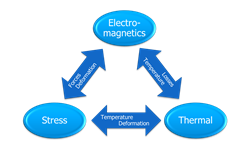
Automated (chained) Multi-physics analysis has been introduced in Opera-3d. This means that it is now possible to use the Modeller to set up several analyses of the same model in a single database and solve them in sequence.
The analyses can solve different physics types: electromagnetic, thermal or stress. The results of one analysis will be used as the data for subsequent analyses. Data such as material properties can be updated using the output of the preceding analysis.
The existing method of multiphysics using table & command files is still available.
Deformed Mesh Input
The deformed mesh from a stress analysis can be automatically used in subsequent electromagnetic and thermal analyses in a chained multiphysics analysis. In the required electromagnetic and/or thermal analysis merely tick "Update mesh with displacements" in the Analysis data dialog.
Parallel Solution
Multi-core Parallel processing is available for Opera-3d solvers. This is controlled using a setting in the batch options, and is a licensed feature. Contact your local representative for further details on likely throughput improvements for your particular analyses.
Sputter Magnetron Coaters
A new volume plasma emitter has been added that can be used to simulate the steady state ion current flow from a magnetized plasma and used to simulate sputter magnetron coaters.
The spatial distribution of the ionized gas created by the high energy electrons is determined and the plasma density at the plasma surface is then calculated. The position of the plasma surface is determined by iteration; the change in electric fields produced by the space charge of ion and electron flow outside the plasma is recalculated at each iteration and the modified ionization rate is then found. A self consistent voltage, ion and electron flow is determined.
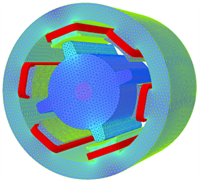
A new machine template was added, which allows modelling of synchronous reluctance machines. Two basic types of rotor geometries were added; circular and trapezoidal rotor voids.
New geometric details were added to the definition of Switched Reluctance Machines in the Opera-3d Machines Environment. In addition, two new analysis types were added:
Magnetostatic - The magnetostatic analysis for SRMs is split into three stages: the first stage creates a series of static jobs for range of current with rotor aligned; the second stage creates series of static jobs for different rotor positions between the aligned and unaligned rotor positions; and the last stage creates series of static jobs for range of current with rotor unaligned. The magnetostatic analysis calculates flux linkage vs. rotor position, flux linkage vs. current for aligned and unaligned positions and torque vs. angle.
Dynamic - The dynamic analysis for the switch reluctance machine uses the mechanically coupled option. Based on the geometry of the machine and on the number of phases selected, the switching strategy is calculated. A hysteretic speed control is implemented as a control strategy. The dynamic analysis calculates torque vs. angle at a given speed and advance angle. It also estimates the iron losses in the stator and or rotor sections.
Related Products
Stamping solution PAM-STAMP ESI Group Discover PAM-STAMP, ESI''s Virtual Sheet Metal Forming Solution!
PAM-STAMP covers major sheet metal forming processes, like Roll hemming, Hot forming, ...
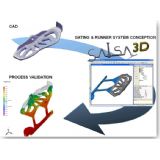
SALSA 3D, a Gating & Runner System Conception tool ESI Group SALSA 3D helps calculate and size, gating and running systems for the High Pressure Die Casting process (HPDC). It assists in designing gates, runners ...
PAM-FORM ESI Group PAM-FORM enables the realistic and predictive simulation of dry textiles or prepregs forming processes. The software was developed through industrial ...
ProCAST / QuikCAST ESI Group ESI offers a set of complementary applications for the foundry industry.
ESI''s Casting Simulation Suite has proven to be an indispensable tool in ...
With IDO:Cooperate ICIDO GmbH With IDO:Cooperate, enterprises have a solution at their disposal for real-time product visualization across locations in real time. Development teams ...
 General:...">



 Stamping solution PAM-STAMP
 SALSA 3D, a Gating & Runner System Conception tool
 PAM-FORM
 ProCAST / QuikCAST
 With IDO:Cooperate