|
New OCTAL PET sheet processing technology benefits molders looking for a competitive advantage
6/7/2012 |
|
|
PET-sheet is an essential material in many food-packaging applications such as baked goods, yogurts, produce, meats, cheeses and deli. In addition, other industries, including electronics, toys, personal hygiene and consumer goods have found PET sheet to meet their needs in packaging applications.
However, there are differences in the manufacturing processes of some PET sheets compared to others. For any packaging thermoformer who is looking for a competitive advantage, it is in their best interest to examine these differences.
The main difficulty in the extrusion of APET sheet lies in the traditional manufacturing process that typically requires the use of granulated resin from a third-party supplier. After delivery from this supplier, the resin needs to be dried in a four-to-six hour energy- intensive operation before being fed into the extruder. From there, the extruder compresses and heats the resin into a melt, which is then transferred to the die and onto the rollers to form the sheet.
Today's new unique direct-to-sheet process (DPET™) from OCTAL eliminates five energy-intensive stages of the conventional sheet production process (pelletizer, SSP, compactor, dryer and extruder). Because now the PET melt can arrive at the calendar stack heated to the proper temperature, so it does not have to be dried and re-melted from the granular form.
Thermoformers should note that this means there is no chance for contamination to enter the system. It ensures a finished polymer that is fully devoid of moisture, thus thermoformers see an elimination of all moisture defects. There is absolute traceability as the resin is constrained to one source - providing origin of the resin and quality. Food processors and packers can now be assured of product purity.
In addition, the uniformity of the sheet allowed OCTAL to design a winder that constructs precision rolls with unnoticeable weave and near perfect formation. Thermoformers benefit from this advantage by being able to minimize side trim, a direct material savings.
Gauge consistency in conventional PET sheeting is in the 3% to 8% range, with 5% as an average. DPET™, on the other hand, is manufactured to a typical caliper variation of +/- 1%. Operationally, this outstanding consistency allows thermoformers to specify a thinner sheet and still achieve package performance in finished trays.
DPET™'s direct-to-sheet process results in a material with superior clarity and gloss. Decision makers, whether food packagers or retailers, know that clarity and gloss both translate into an end user perception of higher quality. The DPET™ surface also allows for subsequent printing processes to allow for high-impact merchandising.
DPET™ can be run at a 10% faster cycle time, and at temperatures up to 5 degrees lower than conventional APET, while still retaining clarity and gloss. This translates directly into lower electricity and overhead costs per finished unit.
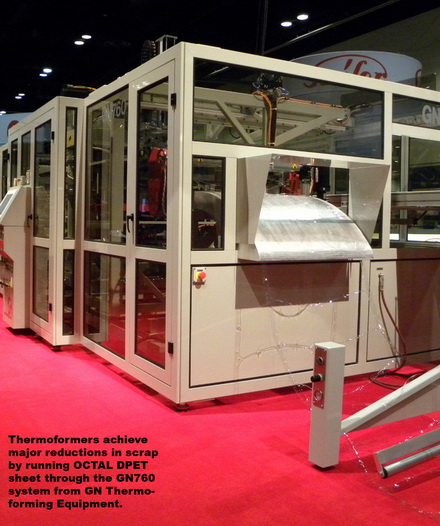
DPET™ has excellent flow characteristics, resulting in 3% to 8% more material reaching inside corners of mold profiles. Combined with an intrinsic viscosity of 0.78, and the implication is, that finished containers are tougher, more resistant to cracking, and better able to withstand the rigors of shipping to retailers and end users. Its high intrinsic viscosity also means less scrap and skeletal waste.
In all, this means a superb new product that cuts costs by as much as 24% compared to conventional PET sheeting, as OCTAL has confirmed in laboratory testing.
"As OCTAL establishes itself as the market leader in PET sheet, more and more thermoformers are finding that DPET™'s physical properties translate directly into competitive advantages for both the thermoformer and the merchandiser," stated William J. Barenberg, Jr., OCTAL's COO. "Thermoformers have been able to reduce cost by ordering a thinner sheet, gain additional business by providing a clearer package and meet many new sustainability requirements from brands and end users."
The OCTAL production process brings a major advantage in addition to the unbeatable product quality: a carbon footprint 25 percent below that of traditionally produced APET films, according to an Intertek study. The direct-to-sheet process eliminates the most energy intensive and defect prone processes, to deliver a spotless sheet with a fraction of the energy.
To learn more about OCTAL's DPET™ visit: www.octal.com |
|
|
|
|
|
主站蜘蛛池模板:
亚洲成人精品综合在线|
欧美亚洲一区二区三区导航|
国产精品成人网址在线观看|
97无码精品人妻毛片|
好吊妞无缓冲视频观看|
av午夜福利一片看久久|
人妖福利导航|
一区二区三区四区五区|
熟妇人妻久久精品一区|
狠狠噜天天噜日日噜|
熟女?国产?精品|
无码中出人妻|
久荜中文字幕|
久久婷婷国产精品香蕉|
国产日韩av二区三区|
国产精品美女一区二区视频|
亚洲国产AV一区二区三区丶|
51午夜精品免费视频|
亚洲一区二区三区在线观看精品中文
|
国产一区国产精品自拍|
丝袜美腿视频一区二区三区|
免费**毛片在线播放|
好男人官网资源在线观看|
91精品国产色综合久久|
一本二本无码|
开阳县|
久久人人爽爽爽人久久久|
成人拍拍拍无遮挡免费视频|
欧美a√|
欧洲AV在线|
久久免费观看午夜成人网站|
肥大bbwbbw高潮抽搐|
最新偷拍一区二区三区|
国产精品亚洲一区二区|
亚洲精品无码久久久久sm|
欧洲亚洲AV|
国产亚洲一区二区三区四区|
国产2页|
日韩精品国产二区三区|
综合五月网|
99在线 | 亚洲|